
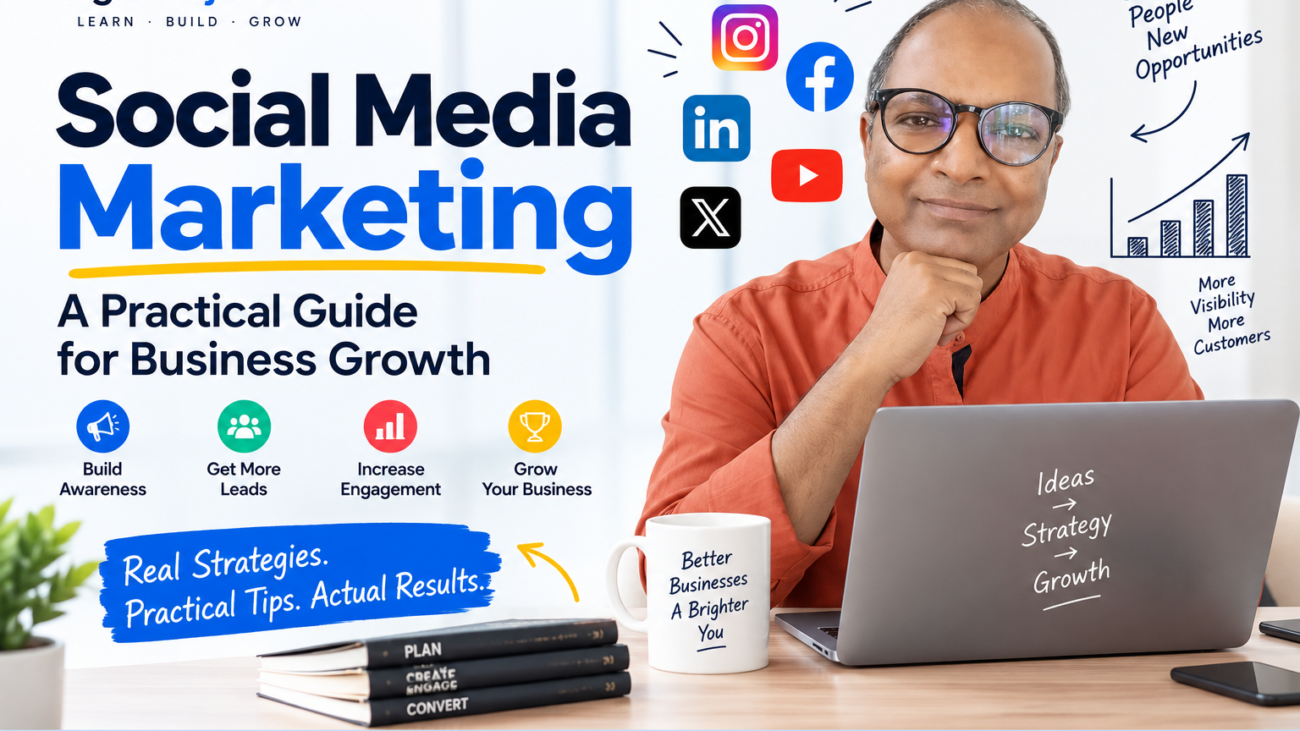
Social Media Marketing: A Practical Guide to Growing Your Business
SEO Title: Social Media Marketing: A Practical Guide for Business Growth
Meta Description: Learn how social media marketing can build trust, attract leads, increase engagement, and grow your business with a practical strategy.
There was a time when a business could depend mainly on a shop, office, referrals, newspaper advertising, or a few local contacts to find customers. Today, your potential customers may discover you while scrolling through Facebook, watching an Instagram Reel, searching YouTube, or reading a LinkedIn post.
That is where social media marketing becomes important.
But here’s something I have noticed: many businesses are active on social media without actually having a marketing strategy. They post occasionally, collect a few likes, and then wonder why those likes don’t turn into customers.
The problem isn’t necessarily social media.
The problem is the way it is being used.
Effective social media marketing is not about posting more. It is about reaching the right people, building trust, demonstrating your expertise, and giving people a reason to take the next step.
What Is Social Media Marketing?
In simple terms, social media marketing is the use of social media platforms to promote a business, build relationships with an audience, create awareness, generate leads, and ultimately drive sales.
It can include:
- Creating educational or entertaining social media content
- Building a business community
- Responding to comments and messages
- Sharing customer experiences and success stories
- Promoting products or services
- Running social media advertising campaigns
- Generating leads through social platforms
- Building personal or business authority
The important thing is that social media should not operate separately from your business.
It should support your larger digital marketing strategy.
Why Does Social Media Marketing Matter?
People generally don’t buy from businesses they don’t know or trust.
Social media gives you an opportunity to change that.
Imagine that someone discovers your business today. They may not be ready to buy immediately. But if they repeatedly see useful content from you, learn something from you, see your experience, and notice how you interact with people, their perception gradually changes.
You move from being a stranger to becoming a familiar and trusted name.
This is especially valuable for coaches, consultants, freelancers, creators, professionals, and small businesses where trust is a major part of the buying decision.
Social media can help you:
- Increase brand awareness
- Establish authority
- Build relationships
- Educate potential customers
- Generate enquiries and leads
- Bring visitors to your website
- Promote products and services
- Stay connected with existing customers
And you don’t necessarily need millions of followers.
A smaller audience that genuinely needs what you offer can be far more valuable than a huge audience that has no interest in your business.
Choosing the Right Social Media Platforms
One of the biggest mistakes I see is trying to be everywhere.
You don’t need to create content for every platform.
Choose platforms based on where your potential customers spend their time and what type of content you can create consistently.
Facebook Marketing
Facebook can be useful for local businesses, communities, service providers, educators, and businesses targeting broad consumer audiences.
Facebook Groups and targeted advertising can also play an important role in lead generation and relationship building.
Instagram Marketing
Instagram is particularly useful when your business can benefit from visual content, short-form videos, Reels, stories, demonstrations, or personal branding.
It can work well for creators, coaches, consultants, lifestyle businesses, retailers, and many consumer brands.
LinkedIn Marketing
LinkedIn is especially valuable for B2B businesses, consultants, professionals, coaches, agencies, recruiters, and founders.
Here, your knowledge can become your marketing asset.
A useful LinkedIn post can demonstrate expertise without making a hard sales pitch.
The lesson is simple:
Don’t choose a platform because everyone else is using it. Choose it because your audience is there.
Building an Effective Social Media Marketing Strategy
Posting randomly is not a strategy.
Before creating content, answer five questions:
Who am I trying to reach?
What problem do they have?
What can I teach or offer them?
Why should they trust me?
What action do I want them to take?
Once you have these answers, your content becomes much easier to plan.
I also recommend having a few consistent content pillars.
For example, a business coach might use:
- Educational content
- Business tips
- Client problems and solutions
- Personal experiences
- Industry insights
- Offers and services
This creates variety without making your content directionless.
Create Content That People Actually Want
Here’s an important shift in thinking:
Don’t ask, “What should I post today?”
Ask:
“What does my audience need to know today?”
That small change can completely transform your content.
Useful content could include:
- How-to guides
- Mistakes to avoid
- Frequently asked questions
- Checklists
- Case studies
- Short tutorials
- Industry observations
- Behind-the-scenes experiences
- Comparisons
- Practical tips
For example, instead of posting:
“We provide excellent digital marketing services.”
You could share:
“Five reasons your Facebook ads may be generating clicks but not customers.”
The second approach gives people a reason to stop scrolling.
Good social media content starts conversations. Great content makes the right person think, “This person understands my problem.”
From Social Media Engagement to Leads and Sales
Likes and followers are useful indicators, but they aren’t the ultimate objective for most businesses.
The real question is:
What happens after someone engages with your content?
You need a simple path.
For example:
Social media post → Profile → Website/landing page → Free resource → Lead → Follow-up → Customer
This is where social media connects with your broader marketing system.
Suppose you are a business coach.
You publish a post explaining how freelancers can package their skills into a profitable service. At the end, you invite interested readers to download a free checklist from your website.
Someone downloads it.
Now you have permission to continue the relationship through appropriate follow-up.
That is much more valuable than simply receiving a “Like.”
Common Social Media Marketing Mistakes
You can save yourself a lot of time by avoiding these mistakes.
Posting Without a Purpose
Every post doesn’t need to sell something, but it should have a purpose.
Educate. Entertain. Inspire. Build trust. Start a conversation. Generate a lead.
Know why you’re publishing it.
Focusing Only on Selling
If every post says “Buy now,” people eventually stop paying attention.
Give value before asking for the sale.
Chasing Followers
Followers are not automatically customers.
Focus on reaching the right audience, not merely a larger audience.
Inconsistent Publishing
You don’t need to post ten times every day.
A sustainable schedule is better than an ambitious schedule you abandon after two weeks.
Ignoring Conversations
Social media is called “social” for a reason.
Reply to comments. Answer questions. Participate in relevant conversations. Listen to what your audience is saying.
Relationships are part of marketing.
How to Measure Your Results
Don’t judge your social media marketing only by likes.
Depending on your objective, track metrics such as:
- Reach
- Engagement
- Profile visits
- Website traffic
- Leads
- Enquiries
- Conversion rate
- Cost per lead
- Sales generated
For example, if your goal is lead generation, getting 10 qualified enquiries may be much more valuable than receiving 10,000 views with no business outcome.
Measure what matters to your business.
A Simple 7-Step Social Media Marketing Action Plan
If you’re starting from scratch, don’t make it complicated.
Follow these seven steps:
1. Define your ideal customer.
Be specific about who you want to reach.
2. Choose one or two primary platforms.
Master them before expanding.
3. Define three to five content pillars.
This keeps your content focused.
4. Create useful content consistently.
Teach something, solve a problem, or provide a fresh perspective.
5. Build relationships.
Respond, engage, listen, and participate.
6. Create a clear path to your offer.
Give interested people an easy way to learn more or contact you.
7. Measure and improve.
Look at what generates meaningful engagement, enquiries, leads, and sales—and create more of what works.
Final Thoughts
I believe social media marketing works best when you stop treating social media as merely a place to advertise and start treating it as a place to build relationships.
You don’t need to become an influencer.
You don’t need millions of followers.
And you don’t need to publish meaningless content every few hours.
You need to understand your audience, communicate useful ideas consistently, demonstrate your expertise, and make it easy for the right people to do business with you.
That is the approach I believe in at DigitalArjun.com: use digital tools and marketing intelligently, but never forget the human being on the other side of the screen.
Build value. Build trust. Build relationships.
The business will have a much stronger foundation as a result.
Frequently Asked Questions
1. What is social media marketing?
Social media marketing is the use of platforms such as Facebook, Instagram, LinkedIn, and other social networks to build awareness, engage audiences, generate leads, and promote products or services.
2. Is social media marketing useful for small businesses?
Yes. Small businesses can use social media to build local awareness, demonstrate expertise, communicate with potential customers, generate enquiries, and develop long-term relationships.
3. Which social media platform is best for marketing?
There is no single best platform. The right choice depends on your target audience, business model, content format, and marketing objectives.
4. How often should a business post on social media?
Consistency is more important than a specific number. A business should choose a realistic publishing schedule that allows it to consistently create useful, relevant content.
5. Can social media marketing generate leads and sales?
Yes. When combined with valuable content, a clear offer, an effective conversion path, and appropriate follow-up, social media can become an important source of leads and customers.
Ready to Turn Social Media Into a Business Growth Engine?
If you’re posting on social media but not getting enough leads, customers, or business opportunities, it’s time to look beyond likes and followers.
At DigitalArjun.com, my focus is simple: helping entrepreneurs, professionals, coaches, consultants, freelancers, and small business owners use digital marketing, AI tools, social media, and their own knowledge and skills to build real business opportunities.
You don’t need to become an influencer.
You don’t need a massive advertising budget.
You need the right strategy, the right tools, the right message, and consistent execution.
If you are serious about using the internet to grow your business, develop a valuable digital skill, or turn your knowledge into an income-generating opportunity, I invite you to take the next step with me.
👉 Visit DigitalArjun.com to explore practical resources, strategies, and tools designed to help you grow in the digital world.
And if you’re ready to stop simply posting and start building a business through digital marketing, let’s make your next move a strategic one.
DigitalArjun.com — Learn. Build. Grow.